THE NEW ESTERO LOCATION IS NOW OPEN! CALL TODAY TO SCHEDULE AN APPOINTMENT. 239-325-2020

Cataract Surgery

Request a Consultation

What Are Cataracts?

We are committed to providing a thorough education for patients seeking treatment for their cataracts and determining the most effective treatment plan for each patient on an individual basis. No evaluation is complete without time for the patient and family to ask the doctor and staff questions.

Cataracts are a clouding of the eyes’ natural lens. Because they block light from passing through the lens, cataracts make it difficult to see clearly and can even cause blindness over time. Cataracts are progressive, meaning they worsen with time. Although cataracts are more common in older adults, people in their 30s, 40s, or even younger can also develop cataracts. Some cataracts are associated with injuries, medications, inflammation, and certain systemic diseases such as diabetes.

For most of our lives, our eyes provide us with good vision, though many of us may require glasses, contact lenses, or refractive surgery to sharpen that vision. Cataracts are far and away the most common treatable cause of poor vision.

REQUEST A CONSULTATION

img
  • icon
  • icon
  • icon

What Are Symptoms of Cataracts?

Ready to Get Started?

Find out if you're a candidate for cataract surgery in just a few clicks!

Take Cataract Self-Test

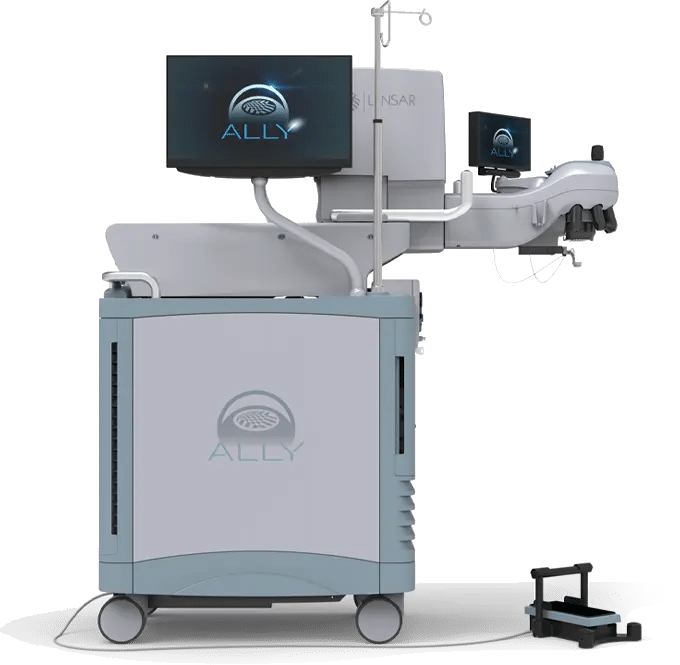
What is the ALLY Robotic Cataract Laser System?

ALLY® robotic-assisted laser cataract surgery is a sophisticated procedure that combines your surgeon’s skill and expertise, robotic technology, and a femtosecond laser to enhance precision and accuracy during cataract removal and lens implantation. This advanced technique offers benefits such as improved surgical outcomes, reduced manual error, and increased efficiency compared to traditional manual techniques.

What Are The Benefits of Refractive Laser Cataract Surgery vs. Traditional Cataract Surgery?

Refractive laser cataract surgery offers better quality results in comparison to standard surgical options for cataract treatment.

Some advantages of laser cataract surgery performed with our LENSAR femtosecond laser include:

  • Having the chance to achieve the best vision possible. Laser cataract surgery offers more accuracy and precision creating incisions.
  • Astigmatism can be greatly reduced or eliminated.
  • Operating time has been proven to be much shorter.
  • A greater post-op experience with your new vision. Refractive laser cataract surgery places the new lens more precisely and accurately.

Refractive laser cataract surgery can also correct astigmatism in most patients. Astigmatism occurs when the cornea is shaped like a football and not a soccer ball. This results in blurred and distorted vision.

Cataract surgery is a transformative medical procedure that has the power to dramatically improve one's quality of life. With advanced surgical techniques and cutting-edge technology at Ginsberg Eye, cataract surgery offers individuals the opportunity to regain clear, vibrant vision and rediscover the world around them.
Take Cataract Self-Test To Get Started

Customized Cataract Surgery with Dr. Ginsberg

Dr. Ginsberg has extensive experience with all intraocular lenses available in the United States and some not available here yet. This allows him to combine surgical skills and experience with his knowledge of your desires to match the appropriate lens with your eye.

At Ginsberg Eye, we are happy to offer no IV cataract surgery to our patients! Instead of using traditional anesthesia that requires an IV, our cataract surgery patients can take a small capsule that provides the necessary medication for surgery.

Multifocal IOLs

  • Extended Depth of Focus IOLs
  • Accommodating IOLs
  • Toric or Astigmatism Correcting IOLs
  • Monovision
  • Aspheric Monofocal IOLs
  • Standard Monofocal IOLs

Cataract Surgery FAQs

What are the symptoms of cataracts that indicate I might need surgery?

Blurry vision, difficulty seeing at night, sensitivity to light, and seeing halos around lights are common symptoms that may suggest the need for cataract surgery.

How is cataract surgery performed, and what can I expect during the procedure?

Cataract surgery involves removing and replacing the clouded lens with an artificial intraocular lens (IOL). The procedure is usually quick, painless, and performed under local anesthesia.

Are there different types of intraocular lenses (IOLs) available for cataract surgery?

Various IOLs are available, including monofocal, multifocal, and toric lenses, which can address different vision needs, such as distance, near vision, and astigmatism.

What are the benefits of laser-assisted cataract surgery compared to traditional methods?

Laser-assisted cataract surgery offers greater precision and can reduce the risk of complications, leading to a quicker recovery for some patients.

How long does the recovery process take after cataract surgery?

Most patients experience improved vision within a few days, but full recovery can take about four to six weeks.

Can cataracts be prevented, or can their progression be slowed down?

While cataracts cannot be entirely prevented, wearing UV-protective sunglasses, maintaining a healthy diet, and avoiding smoking may help slow their progression.

Will I need to wear glasses after undergoing cataract surgery?

Many patients experience improved vision, but depending on the type of IOL selected, some may still need glasses for reading or other specific tasks.

How do I know if I am a candidate for cataract surgery?

If cataracts are affecting your quality of life and vision, you may be a candidate. A comprehensive eye exam will help determine the best course of action.

What are the early warning signs of cataracts?

Early signs include blurry vision, increased sensitivity to light, and trouble seeing in low-light conditions, like at night. You may also notice glare or halos around lights.

How do cataracts affect your vision?

Cataracts cause the eye's lens to become cloudy, which can result in hazy or less sharp vision. This cloudiness gradually worsens over time, affecting daily activities.

Can cataracts cause blurry or cloudy vision?

Cataracts commonly cause both blurry and cloudy vision as they progress.

What are the most common symptoms of cataracts?

Common symptoms include blurry vision, sensitivity to light, glare, and seeing halos around lights.

Do cataracts cause increased sensitivity to light and glare?

Many people with cataracts experience heightened sensitivity to bright light and glare. This can make outdoor activities or driving uncomfortable.

Can cataracts lead to difficulty seeing at night?

Cataracts can cause trouble seeing in low-light situations, making night driving particularly challenging. This is often due to glare from headlights or streetlights.

Are halos around lights a sign of cataracts?

Seeing halos around lights is a typical symptom of cataracts. These halos can become more pronounced as the cataracts progress.

How do cataracts impact color perception?

Cataracts can make colors appear faded or less vibrant over time. This dulling of colors may make it harder to distinguish between similar shades.

Can cataracts cause frequent changes in eyeglass prescriptions?

Cataracts can lead to frequent changes in vision, resulting in the need for updated eyeglass prescriptions. If your prescription changes often, it could be a sign of cataracts.

What are the signs that cataracts are getting worse?

Worsening cataracts typically cause significant cloudiness, increased glare, and reduced ability to see in dim lighting. Colors may also appear more muted, and night vision might become especially poor.

When should I consider Cataract surgery?

Cataract surgery is usually recommended when people feel their quality of life is affected, and their ability to perform normal activities (driving, reading, or sports) is compromised. When you feel that your blurred vision interferes with your day-to-day life, surgical remedies should be considered.

See All