


We are committed to providing a thorough education for patients seeking treatment for their cataracts and determining the most effective treatment plan for each patient on an individual basis. No evaluation is complete without time for the patient and family to ask the doctor and staff questions.
Cataracts are a clouding of the eyes’ natural lens. Because they block light from passing through the lens, cataracts make it difficult to see clearly and can even cause blindness over time. Cataracts are progressive, meaning they worsen with time. Although cataracts are more common in older adults, people in their 30s, 40s, or even younger can also develop cataracts. Some cataracts are associated with injuries, medications, inflammation, and certain systemic diseases such as diabetes.
For most of our lives, our eyes provide us with good vision, though many of us may require glasses, contact lenses, or refractive surgery to sharpen that vision. Cataracts are far and away the most common treatable cause of poor vision.
REQUEST A CONSULTATION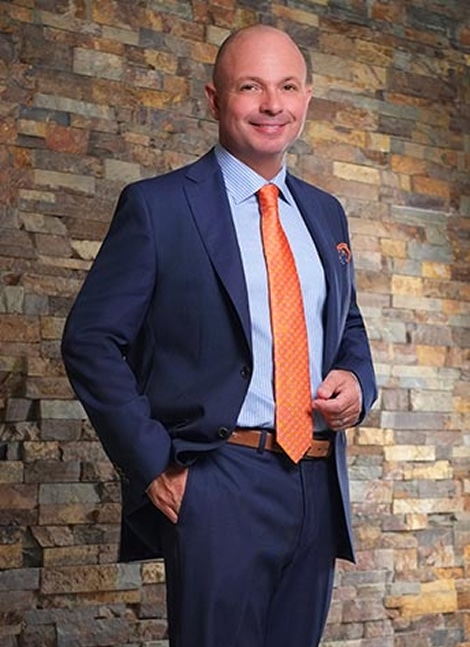








Find out if you're a candidate for cataract surgery in just a few clicks!
Take Cataract Self-Test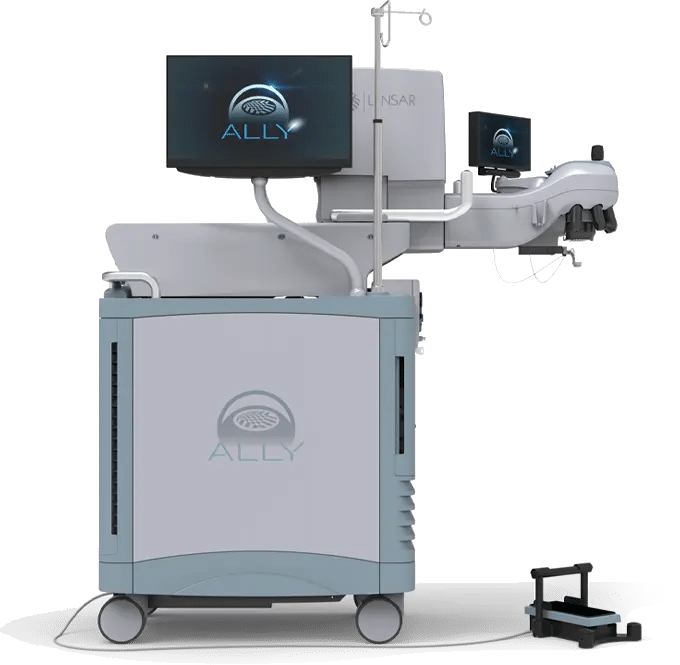
ALLY® robotic-assisted laser cataract surgery is a sophisticated procedure that combines your surgeon’s skill and expertise, robotic technology, and a femtosecond laser to enhance precision and accuracy during cataract removal and lens implantation. This advanced technique offers benefits such as improved surgical outcomes, reduced manual error, and increased efficiency compared to traditional manual techniques.
Refractive laser cataract surgery offers better quality results in comparison to standard surgical options for cataract treatment.
Some advantages of laser cataract surgery performed with our LENSAR femtosecond laser include:
Refractive laser cataract surgery can also correct astigmatism in most patients. Astigmatism occurs when the cornea is shaped like a football and not a soccer ball. This results in blurred and distorted vision.


Dr. Ginsberg has extensive experience with all intraocular lenses available in the United States and some not available here yet. This allows him to combine surgical skills and experience with his knowledge of your desires to match the appropriate lens with your eye.
At Ginsberg Eye, we are happy to offer no IV cataract surgery to our patients! Instead of using traditional anesthesia that requires an IV, our cataract surgery patients can take a small capsule that provides the necessary medication for surgery.




